Aroid Soil Mix
Aroid soil mix is a chunky, well-aerated potting substrate designed to support the root systems of tropical aroid plants such as Monstera, Philodendron, Alocasia, and Anthurium. Unlike traditional potting soil, aroid soil mixes contain larger structural ingredients like orchid bark, pumice, perlite, and coco components that maintain airflow around plant roots while still retaining enough moisture for steady growth.
Aroids evolved in tropical environments where roots grow through loose organic debris rather than compact soil. In rainforests, these plants often grow along tree trunks, in decomposing bark layers, or across forest floors filled with leaf litter and other organic material. Because of this environment, aroids naturally prefer soil structures that contain consistent oxygen movement and fast drainage.
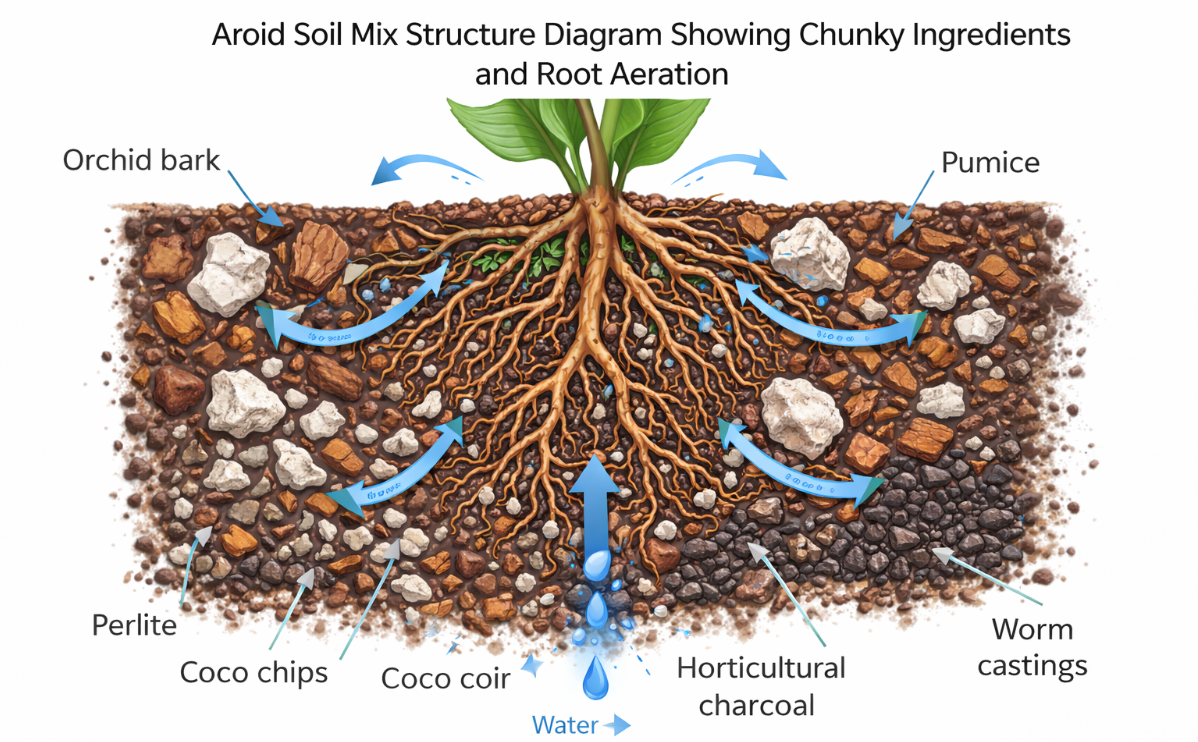
Standard potting soil tends to contain fine particles designed to hold moisture for long periods. While this works well for many plants, aroids often struggle in dense mixes because compact soil can reduce oxygen flow around the roots. When soil stays saturated too long, roots may become stressed or susceptible to rot.
Chunky aroid soil mixes help prevent these problems by maintaining open spaces between soil particles. These air pockets allow oxygen to reach the root system while excess water drains freely through the container. The result is a more stable root environment that supports stronger growth and easier watering management.
For indoor growers, using a structured aroid soil mix can make plant care more predictable and reduce common houseplant problems caused by overly dense soil.
Read: Rainbows & Unicorns Aroid Soil Authority Page →
Buy Rainbows & Unicorns Aroid Soil Mix →
Why Aroids Need Chunky Soil
Aroids such as Monstera, Philodendron, Anthurium, and Alocasia evolved in tropical rainforest environments where soil behaves very differently from typical indoor potting mixes. Instead of growing in dense mineral soil, these plants develop roots in loose organic layers made up of decomposing bark, leaf litter, moss, and forest debris.
This natural substrate structure creates a root environment filled with air pockets, rapid drainage, and consistent oxygen availability. Rainwater moves quickly through these organic layers, preventing the root zone from remaining saturated for long periods.
Because of this evolutionary background, aroid plants are adapted to root environments where oxygen is constantly available and soil particles do not compact tightly together. When grown indoors in dense potting soil, the root system may experience reduced airflow and slower drainage.
Over time, compact soil structures can trap excess moisture in the container, particularly in indoor environments where evaporation is slower than outdoors. When soil remains wet for extended periods, oxygen movement around the roots decreases. This can stress the root system and make watering mistakes more likely.
Chunky aroid soil mixes help solve this problem by using larger structural particles that prevent compaction. Ingredients like orchid bark, pumice, perlite, and coco chips maintain physical space inside the container so that air can move freely through the substrate.
This open structure allows excess water to drain quickly after watering while still retaining enough moisture for plant hydration. The balance between drainage and moisture retention helps create a stable environment where aroid roots can grow naturally.
Many experienced indoor growers find that using a structured aroid soil mix makes plant care more predictable. Watering becomes easier to manage, root systems remain healthier, and plants are less likely to experience problems associated with overly dense potting soil.
Premium mixes such as Rainbows & Unicorns Aroid Potting Mix are designed to replicate these natural soil conditions using a carefully balanced blend of chunky aeration materials and nutrient-supporting organic components.
Aroid Soil Mix Structure (What Each Ingredient Does)
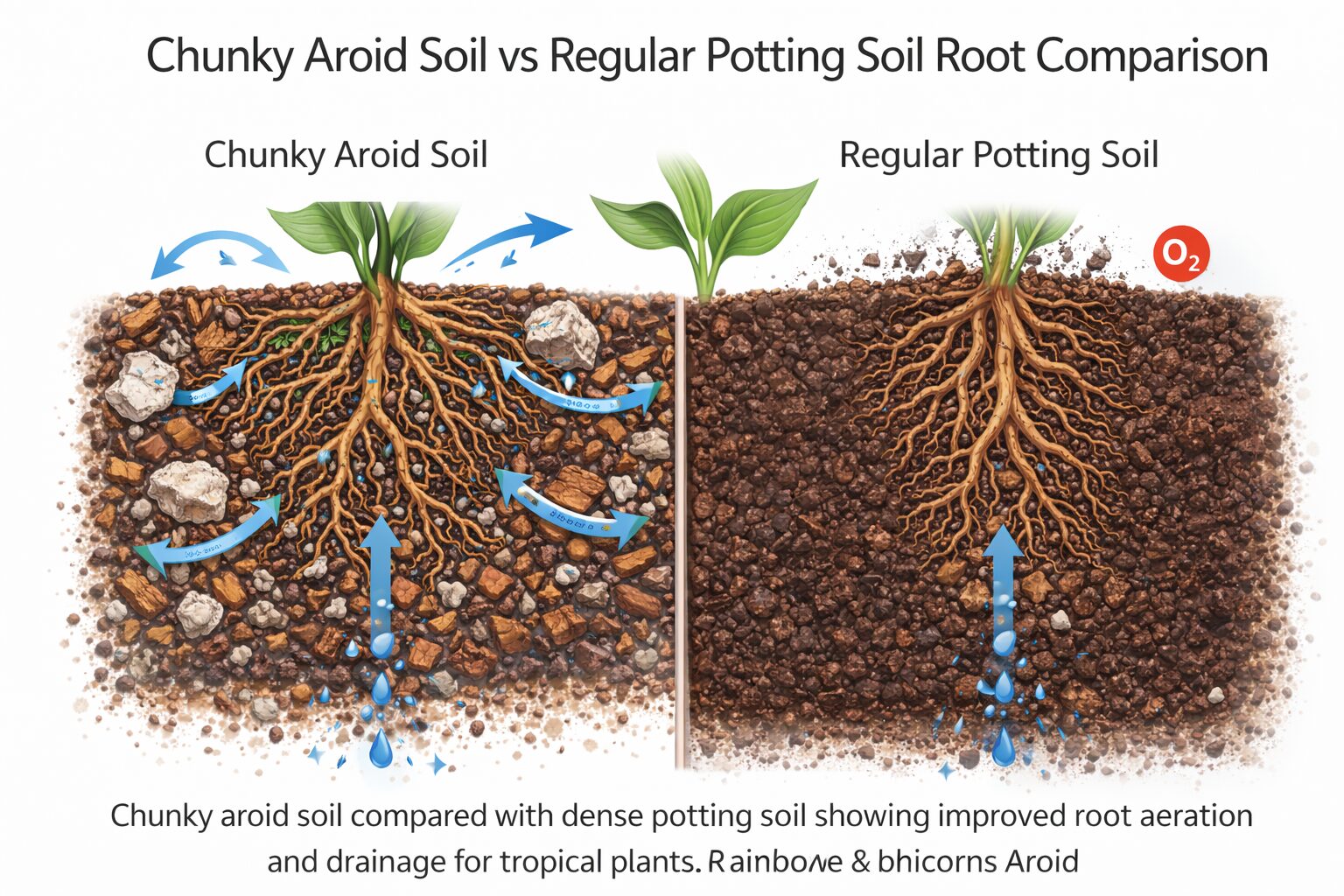
A true aroid soil mix is not “potting soil with bark mixed in.” It’s a structure-first substrate designed to keep air moving through the root zone after watering. To do that, the mix needs multiple particle sizes that work together: large structural pieces to create air channels, mineral components to stabilize drainage, and moisture-retentive fibers that hold usable water without turning the mix dense.
Instead of thinking about ingredients as a checklist, think about them as jobs. If the mix does the jobs, your aroid roots get oxygen, water drains properly, and watering becomes predictable.
Job 1: Create permanent air channels
Large structural particles are the “framework” of the mix. They prevent compaction and preserve void spaces where oxygen can move. This matters because roots don’t just “sit in dirt” — they respire, and respiration requires oxygen.
- Orchid bark — durable structure that keeps the mix open and helps prevent the “wet brick” effect that happens when fine soil compacts.
- Coco chips — chunky, slow-to-break-down fiber pieces that add structure while holding some internal moisture.
Job 2: Improve drainage without making the mix too dry
Drainage is not just “water exits the pot.” It’s also about how evenly water moves through the profile. Mineral components create consistent pathways and reduce muddy zones at the bottom of the container.
- Pumice — porous mineral that adds weight and stability while supporting drainage and root contact points.
- Perlite — lightweight aeration mineral that increases pore space; useful for keeping mixes airy, especially in indoor environments.
Job 3: Hold usable moisture (without waterlogging)
Aroids still need moisture consistency. A mix that drains fast but can’t hold enough usable moisture will force constant watering and can stress the plant. The goal is moisture you can use — not stagnant saturation.
- Coco coir — moisture-retentive fiber that stays more open than many fine organic materials and helps balance the mix.
Job 4: Keep the root zone “fresh” and biologically stable
Some ingredients exist to support overall root-zone stability. They won’t “fix” poor drainage on their own, but they contribute to a healthier system when the structure is correct.
- Horticultural charcoal — helps keep the mix from feeling stale and supports long-term structure in many aroid blends.
- Worm castings — gentle organic amendment that contributes nutrients and microbial activity without making the mix dense (when used lightly).
That’s why structured mixes typically use a blend of these components — not just one or two. It’s a system.
How Chunky Aroid Mix Changes Root Growth and Watering Behavior
When you switch from dense potting soil to a structured aroid substrate, two things change immediately:
- Oxygen availability increases because the mix contains consistent air pockets after watering.
- Water moves more predictably through the container instead of sitting in fine layers.
Dense potting soil often creates a common indoor problem: the top looks dry while the bottom stays wet. That’s because fine particles hold water and slow drainage. Growers water again based on the surface, and the root zone becomes chronically wet.
Chunky mixes reduce that mismatch because water travels between larger particles and exits through drainage holes more reliably. You can water thoroughly, let excess drain, then wait for the mix to reach the correct moisture level again.
If you want a direct comparison page already in your cluster, keep this internal link:
How to Choose the Right Aroid Soil Mix for Your Home
There isn’t one perfect ratio for every home. What matters is matching soil behavior to your environment. Use these rules to dial it in:
If your aroid stays wet too long
- Increase chunk and drainage (more bark, pumice, perlite).
- Check pot size (oversized pots stay wet longer than necessary).
- Confirm drainage holes and avoid trapped runoff in cache pots.
- Improve airflow and light if possible.
If your aroid dries too fast
- Increase moisture stability slightly (a bit more coco coir).
- Use a less-porous pot (plastic holds moisture longer than terracotta).
- Reduce excessive airflow directly hitting the plant.
Watering still matters. Use the watering guide in your cluster:
Where Rainbows & Unicorns Fits in the Aroid Soil System
Once you understand the structure logic, a premium aroid mix becomes simple to evaluate: does it maintain air pockets, drain predictably, and hold usable moisture without turning dense? That’s the functional target for Monstera, Philodendron, Anthurium, Alocasia, and most indoor aroids.
If you want the full product-specific authority explanation and the exact positioning inside your cluster, use the authority page:
Read: Rainbows & Unicorns Aroid Soil Authority Page →
And keep the commercial page link for conversion:
Pot Choice and Container Setup for Aroid Soil Mix
A chunky aroid soil mix performs best when the container setup supports fast drainage and consistent airflow. Even the best substrate can behave poorly in a pot with no drainage, trapped runoff, or a container that is oversized for the root ball. The goal is simple: water goes in, excess drains out, and the root zone stays oxygenated as the mix dries down.
Drainage holes are non-negotiable
Aroids can tolerate many growing styles, but they struggle when water has nowhere to go. If the pot has no drainage hole, moisture accumulates at the bottom and the lower root zone stays wet longer than intended. That increases the chance of root stress and makes watering timing harder to read.
Pot size should match the root ball
Oversizing is one of the most common causes of “my aroid keeps staying wet.” When there’s too much mix relative to the roots, the plant can’t use water quickly enough and the lower zone remains damp. A good rule is to size up gradually—just enough room for new roots, not a giant jump in volume.
Pot material changes dry-down speed
The same aroid soil mix can behave very differently depending on pot material:
- Terracotta (porous) dries faster and increases evaporation through the pot walls. Helpful if your mix stays wet too long.
- Plastic (non-porous) holds moisture longer. Helpful if your environment dries the mix quickly.
- Glazed ceramic behaves like plastic (holds moisture longer) but adds stability for larger plants.
Pick the container based on what your home is doing. If your plants stay wet too long, use more breathable pots, more airflow, and a chunkier structure. If your plants dry too fast, use less-porous pots and slightly more moisture stability.
Cache pots can sabotage drainage
Decorative outer pots are fine, but they can trap runoff and keep the root zone wetter. If you use a cache pot, always empty standing water after watering. Better: use a nursery pot inside a cache pot so you can lift it out, drain fully, then return it.
How to Water Aroid Soil Mix (So You Don’t Overwater)
The biggest misconception with a chunky mix is that “fast draining” means “can’t be overwatered.” Aroid mixes make watering more forgiving, but the fundamentals still apply: roots need oxygen, and oxygen is reduced when the mix stays saturated for too long.
The correct watering method for chunky aroid substrate
- Water thoroughly until water exits the drainage holes. This flushes salts and hydrates the entire profile evenly.
- Let it drain completely. Do not leave runoff sitting in a saucer or cache pot.
- Wait for the correct dry-down before watering again. Timing depends on light, airflow, pot size, and temperature.
How to know when to water again
Instead of calendar watering, use one of these checks:
- Finger check: the top may dry quickly—check deeper than the surface.
- Pot weight: learn the feel of a freshly watered pot vs a pot ready for watering.
- Skewer test: insert a wooden skewer deep and pull it out; dampness tells you what’s happening below the surface.
If you already have the watering page in your cluster, keep the internal link:
Read: How to water chunky aroid mix →
Troubleshooting: When Aroid Soil Mix Isn’t Working
If your aroid is struggling, the issue is usually not “the mix is bad.” It’s almost always a mismatch between mix structure, pot setup, environment, and watering behavior. Use these troubleshooting rules to diagnose fast.
If the mix stays wet too long
- Downsize the pot if it’s much larger than the root ball.
- Increase airflow/light (fans, brighter placement, or stronger grow lighting).
- Increase chunk (more bark / pumice / perlite) and reduce fine material.
- Stop trapped runoff (empty saucers/cache pots after watering).
The mix dries too fast
- Increase moisture stability slightly (a bit more coco coir or finer moisture-retentive component).
- Use a less-porous pot (plastic instead of terracotta).
- Reduce excessive airflow directly hitting the plant.
- Confirm root fit: very root-bound plants can dry fast—repot when needed.
If your aroid shows root stress signs
Common signs include yellowing, slowed growth, drooping that doesn’t improve after watering, or a sour smell from the pot. If you suspect root issues:
- Check drainage and standing water first.
- Verify you are not watering based on the top inch alone.
- If problems persist, inspect roots during repotting and reset into a fresh structured mix.
FAQs About Aroid Soil Mix
What is an aroid soil mix?
Aroid soil mix is a chunky, well-aerated substrate designed to keep roots oxygenated while still holding usable moisture. It typically includes structural components like bark and coco chips plus drainage minerals like pumice or perlite.
Is aroid mix better than regular potting soil?
For many indoor aroids, yes. Chunky mixes reduce compaction, increase airflow, and help prevent soil from staying wet too long—common issues with dense potting soil indoors.
Can I use aroid mix for Monstera and Philodendron?
Yes. Monstera and Philodendron are classic aroids and typically thrive in structured mixes that drain well while maintaining oxygen around the roots.
Do I need to fertilize if I use an aroid mix?
Most aroid mixes are designed for structure first, so nutrition still matters. Use a consistent feeding approach appropriate for your plant and growing season.
Is Rainbows & Unicorns a true aroid soil mix?
Rainbows & Unicorns is positioned as a structured aroid potting mix designed to support drainage, aeration, and balanced moisture retention—key performance targets for indoor aroids.