DIY chunky aroid mix vs pre-made aroid soil is a choice between control and consistency. Mixing your own lets you tune drainage and aeration to your exact environment, while a pre-made blend prioritizes repeatable structure and faster repots. For indoor Monstera and Philodendron, the best option is whichever one keeps roots oxygenated without staying wet too long.
Both approaches can produce excellent results. However, the decision usually comes down to how much time you want to spend sourcing and mixing ingredients, how consistent your results need to be, and whether you are potting a handful of plants or managing a larger collection. In either case, neither is automatically better — they solve different problems for different growers.
If you are still building your understanding of aroid substrates, start with the Aroid Potting Mix hub and the Rainbows & Unicorns authority page. For growers ready to try a pre-made option, the Rainbows & Unicorns product page covers sizing and ordering.
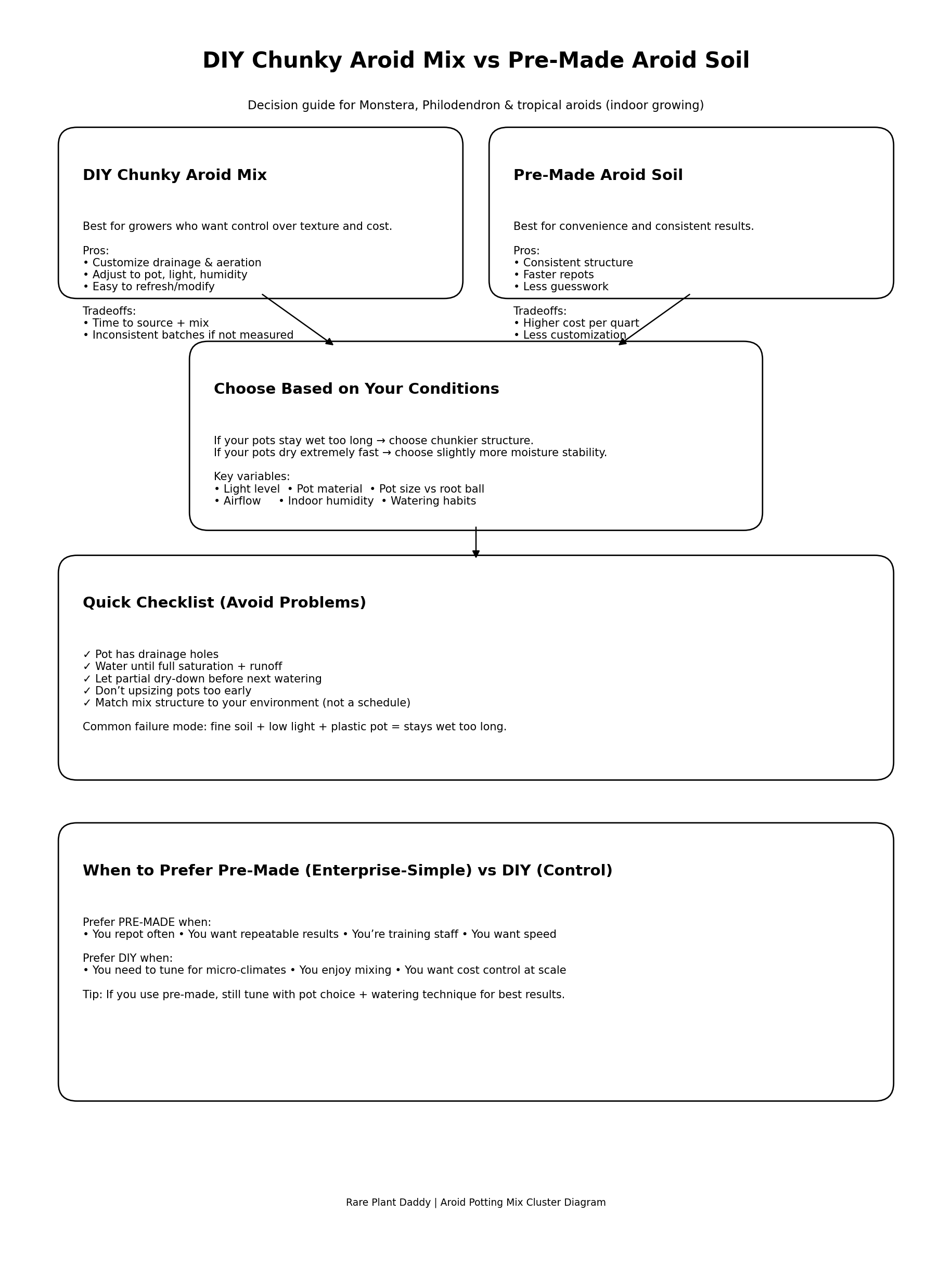
Direct Answer: Which Should You Choose?
- Choose DIY if you want to customize structure (chunkiness), control cost, and adjust for micro-conditions.
- Choose pre-made if you want consistent results, faster repots, and repeatability across many plants or staff.
DIY Chunky Aroid Mix: What It’s Best For
Building your own aroid mix gives you the most direct control over the substrate. You can dial in how chunky the structure is, how fast it drains, and how much moisture it retains based on your specific growing environment. That level of customization is genuinely useful when your conditions are unusual — very low light, very high humidity, unusually large or small pots, or plants that have specific needs.
In addition, mixing your own scales well in terms of ingredient cost. If you are managing a large collection, sourcing bark, perlite, coco coir, and other components in bulk can reduce the per-liter cost compared to buying pre-made substrate. However, the tradeoff is time, consistency, and the fact that ingredient quality and particle size can vary between suppliers and batches.
For these reasons, a homemade mix is a strong choice for:
- Growers who want to tune drainage and aeration precisely
- Homes where pots stay wet too long — low light, plastic pots, cooler temps
- Scaling media cost with larger plant volume
- Adjusting recipes for different pot sizes and humidity levels
For guidance on ratios and mixing order, see the aroid potting mix recipe page and the aroid soil ingredients breakdown.
Pre-Made Aroid Soil: What It’s Best For
A pre-made aroid mix removes the sourcing and mixing variables from the equation. As a result, you start with a substrate already formulated around drainage, aeration, and moisture balance for tropical aroids.
That consistency matters when you are repotting many plants, training someone else to repot, or simply want the process to be faster and more repeatable.
However, the downside is less flexibility. If your environment is unusual — extremely dry, extremely humid, or your lighting and airflow are significantly different from average indoor conditions — a fixed formula may not be perfectly optimized without adjusting pot choice, watering technique, or pot material alongside the mix.
Pre-made is a strong choice for:
- Repeatable batches with less variability
- Fast repots and less sourcing time
- Training staff or helpers to follow a consistent standard
- Growers who want fewer moving parts in their process
How to Decide Based on Your Environment
The most important variable is not whether you mix your own or buy pre-made. Instead, it is whether the final substrate matches your growing environment. A well-built DIY mix and a well-formulated pre-made blend should both produce similar results if paired correctly with the right pot, watering approach, and light conditions.
If your pots stay wet too long
- Use chunkier structure — more bark, perlite, or pumice
- Downsize pots closer to the root ball
- Increase airflow and light if possible
- Switch from plastic to terracotta to accelerate dry-down
If your pots dry too fast
- Use slightly more moisture stability — more coco coir or coco pith
- Check pot material — terracotta dries faster than plastic
- Adjust watering technique before changing the substrate formula
For more on how pot choice interacts with substrate behavior, see best pots for chunky aroid mix.
Consistency vs Customization
DIY mixes can outperform pre-made media when measured and built consistently, but variability between batches is the most common DIY failure point. For example, different brands of bark break down at different speeds. Coco coir moisture content also varies by source, and perlite particle size is not uniform across suppliers. As a result, those inconsistencies accumulate and make it harder to troubleshoot when a plant starts struggling.
Pre-made mixes reduce variability. However, you may still need to tune with pot choice, watering technique, and indoor conditions. No substrate — DIY or pre-made — removes the need to understand what your plants and environment need.
The best approach for most growers is to understand the principles behind chunky aroid substrate structure and then choose whichever method fits their workflow. For a direct structural comparison, see chunky aroid mix vs potting soil and chunky aroid mix vs regular potting soil.
Quick Checklist (Avoid Problems)
Regardless of whether you go DIY or pre-made, these fundamentals apply:
- Use pots with drainage holes — always
- Water until full saturation and runoff
- Allow partial dry-down before watering again
- Avoid oversizing pots relative to the root ball
- Match mix structure to light, airflow, and humidity — not a fixed schedule
Recommended Next Steps in This Cluster
- Aroid Potting Mix Hub
- Aroid Potting Mix Recipe
- Aroid Soil Ingredients
- Chunky Aroid Mix vs Potting Soil
- Chunky Aroid Mix vs Regular Potting Soil
- How to Water Chunky Aroid Mix
- Best Pots for Chunky Aroid Mix
- Rainbows & Unicorns Authority Page
- Rainbows & Unicorns Product Page