← Back to Aroid Potting Mix Hub
Which Is Better for Indoor Tropical Plants?
Chunky aroid mix and regular potting soil behave very differently in containers. A chunky aroid mix usually drains faster, holds more air around the roots, and resists compaction better over time, while dense potting soil often stays wet longer and compresses more easily indoors. For Monstera, Philodendron, Anthurium, Alocasia, and many other tropical houseplants, soil structure often matters more than people realize because roots need both moisture and oxygen to stay healthy.
When growers compare chunky aroid mix vs potting soil, they are really comparing two root environments. One is built for airflow, faster drainage, and long-term structure. The other is usually designed as a more general-purpose growing medium that may work well for some plants but can stay too dense for many tropical species when grown indoors. That is why growers looking for better root aeration often move toward premium chunky mixes like Rainbows & Unicorns Aroid Potting Mix instead of relying on standard fine-textured potting soil.
This guide breaks down the real differences between chunky aroid substrate and regular potting soil, including drainage, oxygen flow, compaction, watering behavior, and when each type of mix makes the most sense for indoor tropical plants.
What Is the Difference Between Chunky Aroid Mix and Potting Soil?
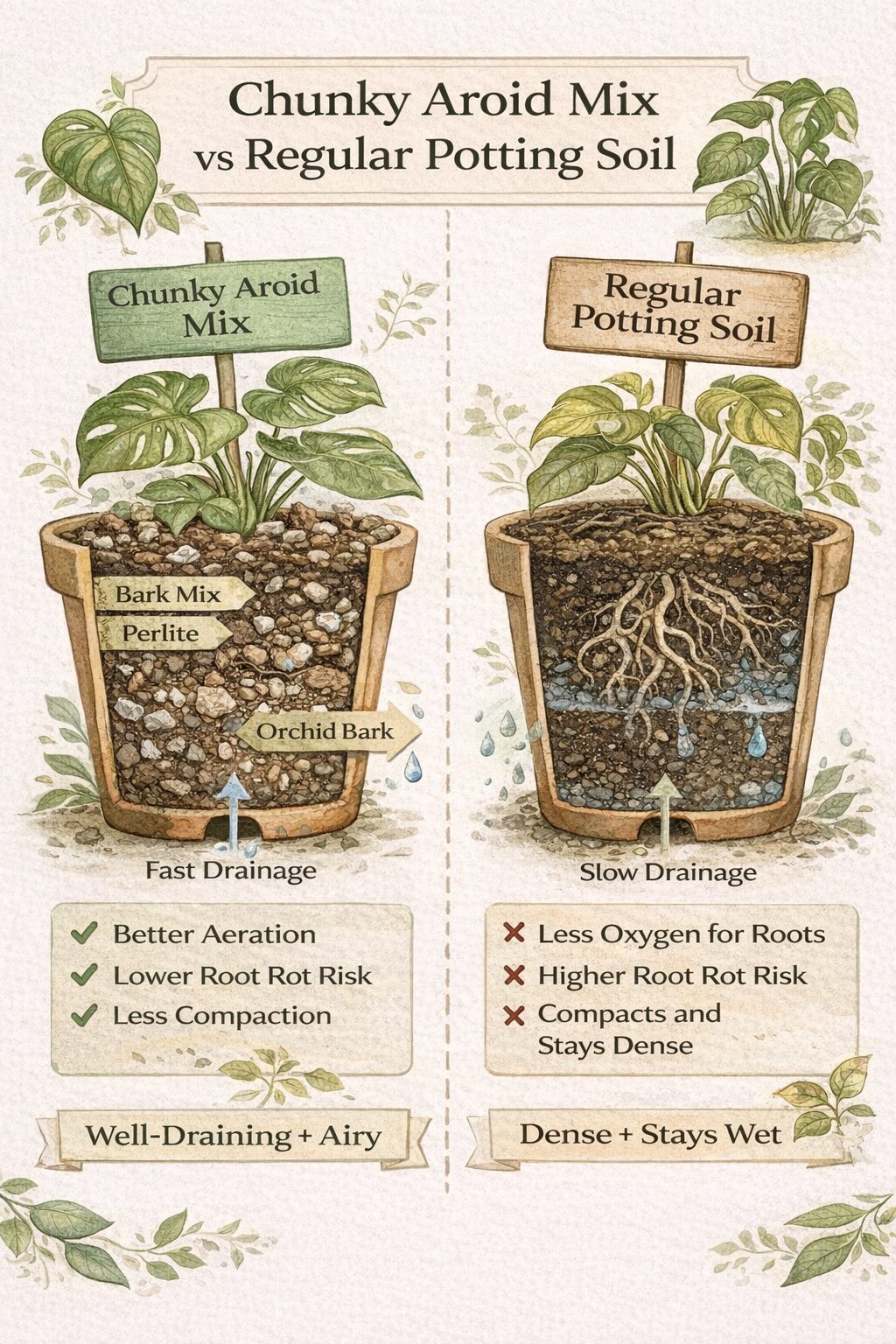
The biggest difference between chunky aroid mix and regular potting soil is particle size and structure. Chunky aroid mix uses larger materials that create air pockets throughout the container. Regular potting soil is usually finer, more uniform, and more moisture-retentive. That difference affects how quickly water leaves the pot, how much oxygen reaches the roots, and how easy it is for the soil to stay structurally open after repeated watering.
Aroid plants and many tropical houseplants often respond better to a chunkier substrate because their roots perform best in a breathable environment. While they still need moisture, they do not usually want a dense root zone that stays soggy for long periods. This is why growers comparing aroid mix vs potting soil are usually trying to solve a real plant problem such as slow drying soil, root rot, weak growth, or roots that stay suffocated in compact media.
Why Soil Structure Matters More Than Most Growers Think
Soil is not just a place to hold the plant upright. It is the root environment. Inside that root zone, the plant needs a balance of water, oxygen, stability, and nutrient access. If the soil is too fine and stays wet too long, the roots can lose access to air. If it compacts repeatedly, water movement slows and the plant becomes harder to manage. In indoor growing conditions where airflow is lower and containers dry more slowly than outdoor beds, this becomes even more important.
Chunky aroid mix is designed to solve that structural problem. It creates larger pore spaces and helps preserve root oxygen after watering. Potting soil can still work for some plants and some environments, but when growers start dealing with root issues, fungus gnats, or slow drying pots, it is often the soil structure that needs to change first.
Chunky Aroid Mix Tends To Offer
- Faster drainage after watering
- More airflow around roots
- Less long-term compaction
- Better margin for overwatering mistakes
- Stronger fit for aroids and tropical houseplants
Regular Potting Soil Tends To Offer
- Greater water retention
- Finer texture throughout the mix
- Slower drying indoors
- More risk of compaction with repeat watering
- Broader general-purpose use depending on plant type
How Chunky Aroid Mix Works
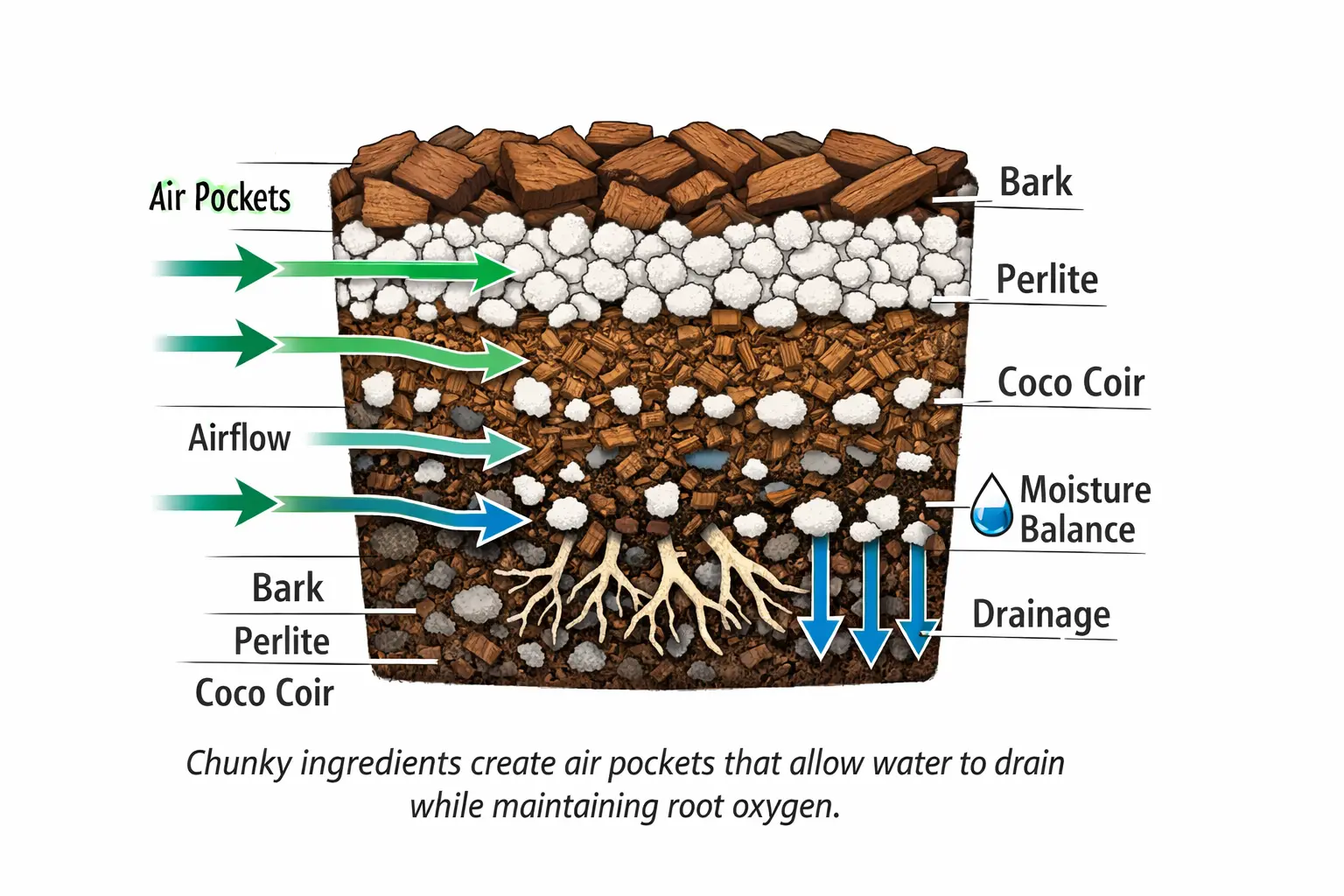
Chunky aroid mix works by combining ingredients that create a more open root environment. Instead of packing tightly together, the particles form spaces between them. Water can move downward more easily, and oxygen can move through the root zone more effectively after watering. That is the core mechanical advantage of a chunky mix.
A high-quality chunky aroid substrate usually blends structural pieces with moisture-balancing components. That means the goal is not simply “dry soil.” The goal is a root zone that holds usable moisture without collapsing into a heavy, airless mass. Rainbows & Unicorns Aroid Potting Mix is positioned around exactly that concept: premium chunky structure, better drainage, root aeration, and support for tropical plant growth.
Chunky Aroid Mix vs Potting Soil: Side-by-Side Comparison
When Potting Soil Causes Problems Indoors
Regular potting soil can work well in the right situation, but many indoor growers run into the same problems when the mix is too dense for the plant or environment. Plastic pots, decorative cachepots, large containers, low light, and limited airflow all make soil dry more slowly. A fine mix that might be manageable outside or in bright, dry conditions can stay wet far too long inside a home.
That is where comparisons like chunky aroid mix vs potting soil become practical, not theoretical. If the plant is yellowing, roots are struggling, or the soil remains wet for days longer than it should, switching to a more breathable structure often solves the issue faster than trying to “water better” inside a mix that is fundamentally wrong for the setup.
Signs dense potting soil may be the problem
- The top stays dark and damp for too long after watering
- The pot feels heavy for many days
- Roots are brown, weak, or starting to rot
- Fungus gnats appear repeatedly
- The soil becomes dense and hard after repeated watering
What Plants Benefit Most from Chunky Aroid Mix?
Chunky aroid mix is especially useful for plants that prefer faster drainage, good root aeration, and a more open substrate. This includes many of the most popular indoor tropical plants. Monstera and Philodendron are the obvious examples, but Anthurium, Alocasia, Syngonium, pothos, and other tropical houseplants often respond well to a structured mix that avoids waterlogged conditions.
The point is not that every tropical plant must be grown in exactly the same substrate. The point is that many indoor growers are better served by a mix that prioritizes drainage and airflow than by a generic potting soil that stays wet too long. When those growers search for the best soil for Monstera or best soil for Philodendron, they are often really describing the same need: a chunkier, more breathable root environment.
Can You Improve Potting Soil Instead of Replacing It?
Yes. Many growers try to modify regular potting soil by adding perlite, bark, coco chunks, pumice, or other coarse materials. That can work, and it is one reason comparison pages like DIY chunky aroid mix vs pre-made aroid soil matter. The challenge is consistency. If the base mix is very fine or water-heavy, the grower still has to guess how much structure to add and whether the final result will actually behave the way they want in their environment.
A premium pre-made chunky mix simplifies that problem. Instead of building a substrate by trial and error, the grower starts with a formula already designed around drainage, root aeration, and tropical plant performance. That is one reason growers looking for reliable structure often move from general potting soil to purpose-built aroid mixes.
Why Rainbows & Unicorns Fits This Comparison
Rainbows & Unicorns Aroid Potting Mix is a strong example of what growers are usually trying to find when they search chunky aroid mix vs potting soil. It is positioned as a premium chunky aroid substrate designed for Monstera, Philodendron, Syngonium, pothos, and other tropical houseplants, with a focus on balancing air, water, and nutrients in the root zone.
The product’s on-page positioning emphasizes chunky coco coir, coco pith, perlite, worm castings, compost, azomite, humic acids, and microbial support materials, all framed around drainage, aeration, and healthier root performance for aroids and tropical plants. That makes it a natural fit for growers who have outgrown generic potting soil and want a more structured, purpose-built mix for indoor tropical plants.
Learn more on the Rainbows & Unicorns authority page, explore the product page, or compare it to other substrate structures through the rest of the aroid soil cluster.
Frequently Asked Questions
Is chunky aroid mix better than regular potting soil?
For many aroids and tropical houseplants grown indoors, yes. Chunky aroid mix usually gives roots better airflow and faster drainage than regular potting soil, which can make it easier to avoid soggy root conditions.
Why does chunky mix drain faster?
Chunky mix drains faster because it contains larger particles and more pore space. That gives water a clearer path through the pot and leaves more oxygen around the roots after watering.
Can I use regular potting soil for Monstera or Philodendron?
You can, but many growers find that regular potting soil stays too dense or wet in indoor conditions. That is why chunky mixes are often preferred for Monstera and Philodendron.
Will chunky aroid mix dry too fast?
It depends on light, humidity, airflow, and pot size. A chunky mix dries faster than dense soil, but a well-balanced formula still holds usable moisture while giving roots more air.
Can I improve potting soil by adding perlite or bark?
Yes. Many growers add coarse materials like perlite or bark to improve drainage and airflow. A pre-made chunky mix simply makes that structure more consistent and easier to use.