What It Is, Why It Works, and When to Use It
A chunky soil mix is a coarse, airy potting blend made with larger particles like bark, perlite, pumice, coco chunks, and other structural ingredients that create oxygen space around roots while still holding enough moisture to support healthy growth. It is commonly used for Monstera, Philodendron, Anthurium, Alocasia, and other tropical houseplants that struggle in dense, compacted potting soil.
For readers building a stronger foundation first, start with the main aroid potting mix hub, the brand authority page for Rainbows & Unicorns Aroid Potting Mix, and the product page for Rainbows & Unicorns Tropical Houseplant Potting Mix – Aroid Blend.
What makes a potting mix chunky?
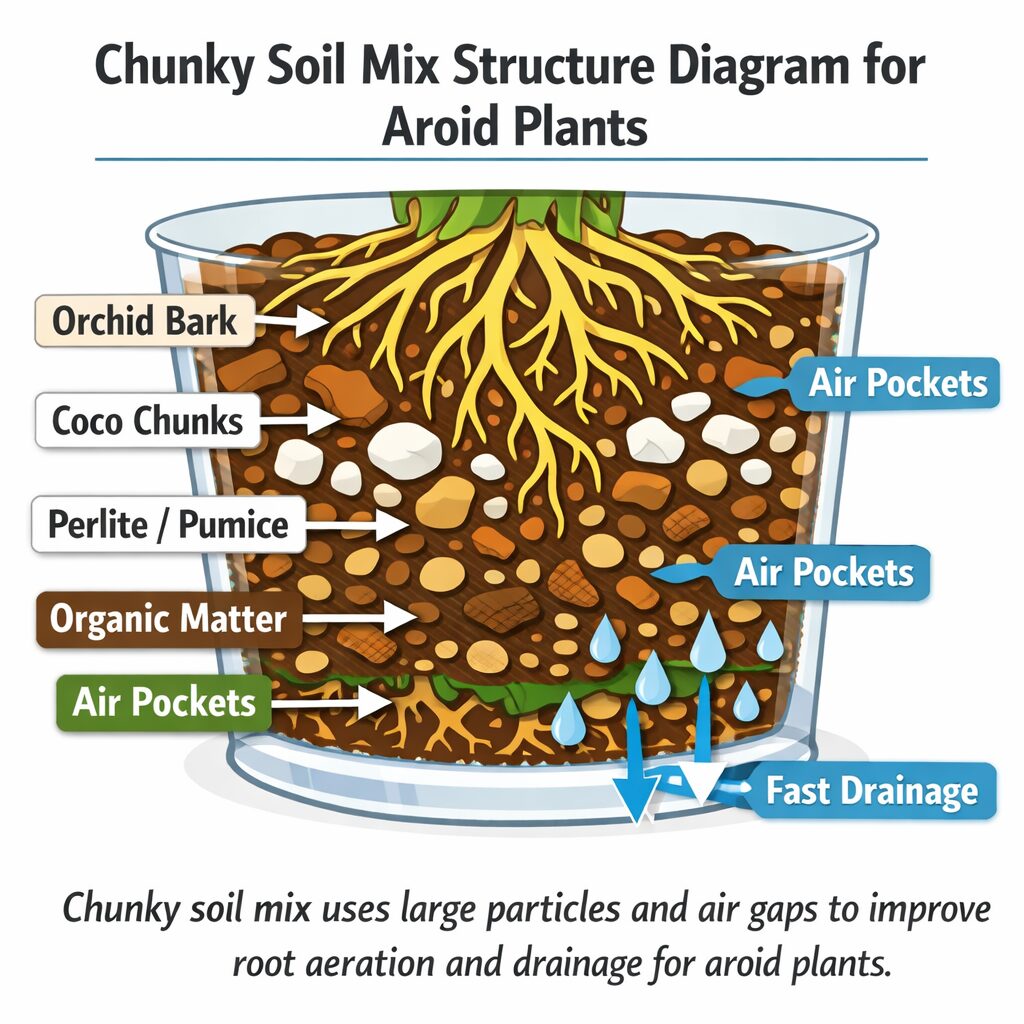
A chunky soil mix is a potting medium built around structure rather than fine texture. Instead of relying mostly on peat or dense composted material, it uses larger particles that resist collapse. Those particles create spaces between ingredients, and those spaces matter because roots need both water and oxygen. In a compact mix, water lingers too long and oxygen drops. In a chunky mix, excess water moves through faster and fresh air returns to the root zone more easily.
That is why chunky soil mixes are so often recommended for aroids and other tropical houseplants with thick, vigorous root systems. Many of these plants grow in nature in environments where roots experience constant airflow, quick drainage, and loose organic debris rather than heavy, muddy soil. A chunky mix helps recreate that balance indoors.
If you want the larger category context, see what is aroid soil and what is chunky aroid mix. Those pages connect directly to this topic and help reinforce the broader substrate ecosystem.
University horticulture programs commonly recommend well-draining container media for tropical houseplants to maintain oxygen around the roots and prevent compaction. Research from the University of Minnesota Extension houseplant program explains how potting media structure affects root health, drainage, and watering behavior in indoor plants.
Why coarse, airy potting media work better for many tropical houseplants
The root zone is where most potting problems begin. Leaves may yellow, growth may stall, and plants may decline above the soil line, but many of those symptoms are really root environment problems. A chunky soil mix improves that environment in several ways.
First, it improves drainage. Drainage is not just about water running out of the bottom of the pot. It is about how quickly excess water leaves the spaces between particles after watering. Large particles create larger pore spaces, and those pores help gravitational water move downward rather than staying packed around roots.
Second, it improves oxygen flow. Roots actively use oxygen. When a mix stays waterlogged too long, those oxygen levels drop and roots struggle. In severe cases, root rot organisms gain an advantage because stressed roots are easier to damage. Chunky mixes reduce that risk by restoring air faster after each watering cycle.
Third, it supports stronger root exploration. When the potting mix stays loose and structurally stable, roots can move through it more naturally. Instead of sitting in a dense, soggy mass, the plant can grow into a matrix of moisture pockets and air gaps.
Fourth, it gives growers more control. Fine, water-retentive mixes can swing too wet for too long, especially indoors where evaporation is slower. Chunky blends make watering more forgiving for many species because they lower the chance of suffocating the root zone after a thorough drench.
This is one reason premium chunky blends such as Rainbows & Unicorns Aroid Blend fit naturally into the tropical houseplant category. The value is not in the word “chunky” alone. The value is in how the structure manages air, water, and nutrient movement around roots.
What ingredients are usually in a coarse aroid mix?
A chunky soil mix can be built in different ways, but the best versions usually combine structural ingredients with moisture-balancing ingredients and nutrient-supporting ingredients. The goal is not random texture. The goal is a root zone that drains well, breathes well, and stays usable long enough between repots.
Orchid bark or bark fines are often the backbone of chunky mixes. Bark creates structure, encourages airflow, and helps keep the blend from compacting too quickly. It also creates a more open texture that many aroids prefer.
Perlite or pumice are frequently used for aeration and drainage support. Both help create air pockets in the mix. Perlite is lighter and more common in commercial blends, while pumice is heavier and often more durable in the pot over time.
Coco chunks or chunky coco coir help bridge the gap between drainage and moisture retention. They add structure while still holding some water, which is useful for tropical plants that do not want to dry out bone-dry between waterings.
Coco pith, fine coco coir, or a small amount of organic base material may be included so the mix does not dry too fast. A purely coarse mix can be too dry in some homes, especially for smaller pots or lower-humidity growing spaces. A good chunky mix balances air with usable moisture.
Compost, worm castings, or nutrient-rich organic components may be added in moderation to improve microbial life and nutrient availability. These ingredients should support the system, not dominate it. Too much fine, rich material can close the mix up.
Amendments such as humic acids, mineral trace inputs, fertilizer, or microbial enhancers may also be included depending on the formula. These are support tools, but the structure of the mix still matters most. No amendment fixes a root zone that stays too dense and airless.
For a deeper ingredient-specific breakdown, visit aroid soil ingredients and aroid potting mix recipe.
Chunky potting substrates are not the same as dry soil
One of the biggest beginner mistakes is assuming that chunky means the plant should be kept nearly dry. That is not what this page means. Chunky soil mix is about structure, not neglect. A well-built chunky mix can still retain meaningful moisture inside bark fibers, coco materials, organic matter, and root surfaces. It simply does not trap stagnant water the way dense, compacted soil often does.
In practice, this means a chunky blend often needs thorough watering when it does need water. Instead of tiny sips on a schedule, growers usually get better results by watering evenly until runoff, then letting the mix move back toward the right air-water balance before watering again.
That balance changes with pot size, humidity, light level, airflow, plant size, and ingredient ratio. A small plant in a very large pot can still stay too wet, even in a chunky mix. A fast-growing Monstera in bright light may dry a chunky mix quickly. The mix matters, but the full growing setup matters too.
Chunky substrates compared with regular potting soil
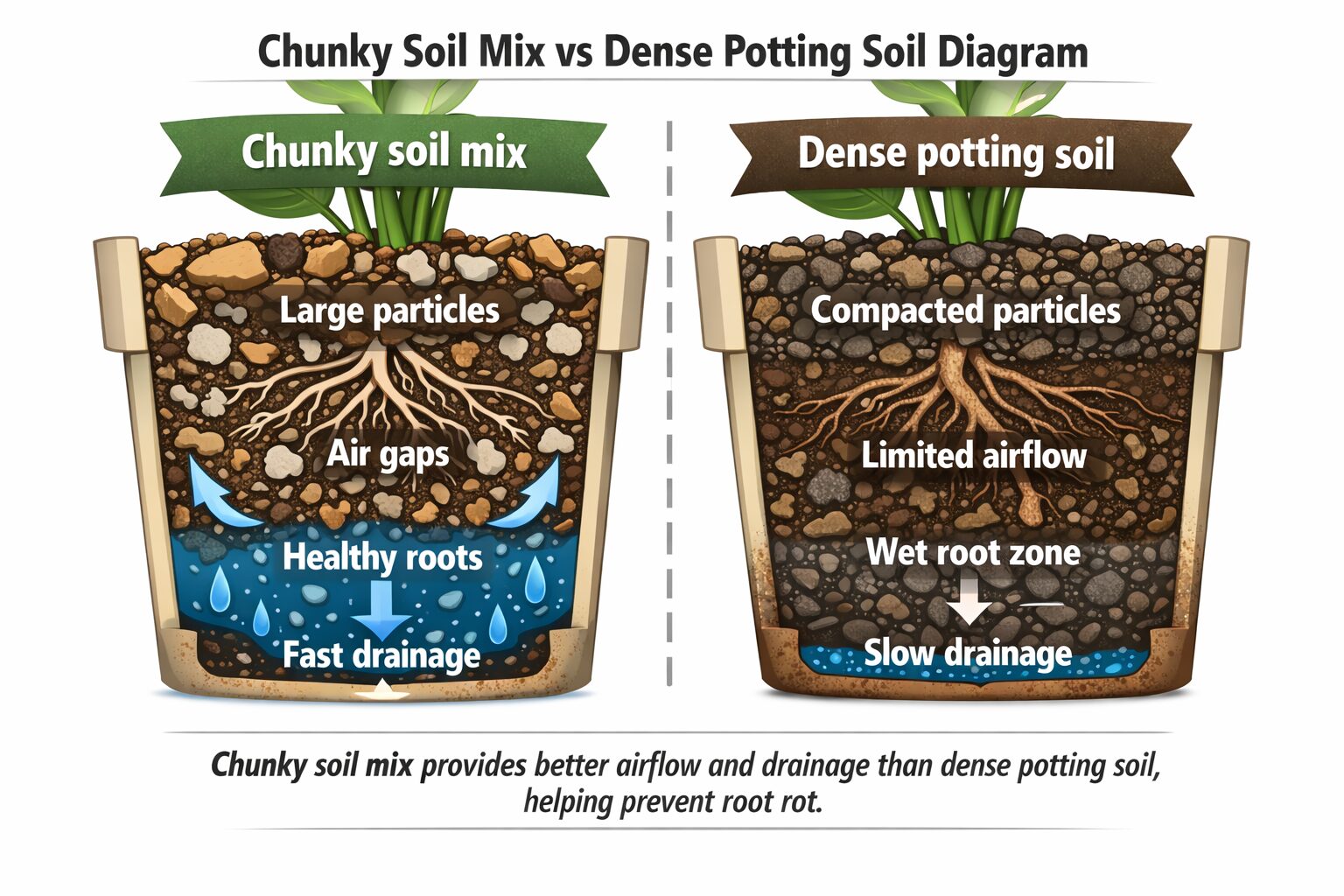
Regular potting soil is often built for broad use across many plants and many retail situations. It may work well for some species, especially moisture-loving plants or outdoor container setups. But for many aroids and collector-style tropical plants, general potting soil can become too dense, especially after repeated watering cycles.
Dense potting soil tends to have smaller particles packed closer together. When saturated, those fine particles hold water more continuously around the root system. Over time, the mix can settle further, reducing oxygen space. That is where growers begin to see slow drying, root stress, fungus gnat pressure, or chronic overwatering symptoms even when they are not watering very often.
A chunky soil mix solves a different problem. It prioritizes root aeration, fast drainage, and structural stability. It is not automatically better for every plant, but it is often better for plants that need a more breathable root zone. Monstera, Philodendron, Anthurium, many Alocasia, and other tropical houseplants often respond well to this style of substrate.
For direct comparison pages in the cluster, see chunky aroid mix vs potting soil and chunky aroid mix vs regular potting soil.
Plants that benefit most from airy potting mixes
Monstera are among the most obvious examples. Their thick roots and climbing growth habit generally pair well with airy, fast-draining substrates. If you grow Monstera deliciosa, this style of mix is often easier to manage than generic potting soil. You can also compare this topic with best soil for Monstera.
Philodendron often thrive in a chunky, oxygen-rich blend, particularly larger climbing or crawling species. A dense mix can stay wet too long around the roots, while a chunkier mix supports healthier drying cycles. Related reading: best soil for Philodendron.
Anthurium and Alocasia can also perform well in structured mixes, though the exact ratio may need adjustment depending on species, pot type, and environment. Some growers keep these slightly more moisture-retentive than an aggressively chunky Monstera blend, but they still usually benefit from better root aeration than standard potting soil provides.
Pothos, Syngonium, and many other tropical houseplants may also enjoy chunky mixes if the blend matches the growing environment. The point is not to force every plant into the chunkiest possible substrate. The point is to improve the root environment for plants that decline in compact, waterlogged conditions.
How to know if your current potting mix is too dense
Plants often tell you when the substrate is working against them. If your mix stays wet for too long, the first signs may be subtle. The top may dry while the lower root zone stays soggy. Growth may slow. Leaves may lose color intensity. The pot may feel heavy for days after watering. Fungus gnats may become persistent. Roots may look brown or weak during repotting instead of white and active.
A dense mix is especially likely if you notice one or more of these patterns:
- The plant stays wet for a week or longer under normal indoor conditions.
- The soil surface crusts or compacts after repeated watering.
- New growth is smaller even though light and temperature are acceptable.
- You find mushy roots during repotting.
- You are constantly trying to “water less” rather than fixing the root environment.
In many cases, the better solution is not simply reducing water. It is moving the plant into a more open, usable substrate. A chunky soil mix changes how water behaves in the container, which often solves the real problem more effectively.
How to use a coarse aroid blend correctly
Using chunky soil mix well is about pairing the substrate with correct potting practice. Start with a pot that matches the root ball rather than overpotting. If the container is far too large, even a chunky mix can stay wet longer than the plant can use.
Position the plant so the root crown sits at the proper level. Fill around the roots with the mix while gently working it into open spaces. Do not mash the mix down hard. One of the benefits of a chunky soil mix is the pore space between particles, and overly aggressive packing reduces that benefit.
Water thoroughly after potting so the ingredients settle naturally around the roots. Then monitor the drying pattern. Do not assume your old watering schedule still applies. A chunkier blend may dry differently, especially in terracotta, small pots, or bright, warm rooms.
Rainbows & Unicorns Aroid Potting Mix fits this use case as a structured tropical houseplant substrate designed for aroids and similar plants. It can be used as a pre-made option for growers who want the benefits of a chunky root-zone environment without having to source and combine multiple components on their own.
When to repot into a fast-draining substrate
The best time to switch a plant into chunky soil mix is usually when the current substrate is no longer serving the plant well. That may be during a normal repot, after signs of poor drainage, or when the existing medium has broken down and compacted.
You should strongly consider repotting if the root ball stays wet too long, roots are circling in exhausted media, or the plant has outgrown the physical and structural limits of the current mix. Repotting is also useful when you buy a plant in a nursery medium that is too dense for your home conditions.
When repotting, remove only as much old soil as the root system can tolerate. The goal is to improve the environment, not to create unnecessary stress. If roots are healthy, a gradual transition into a chunky mix is usually enough. If the lower roots are compromised, trim damaged tissue first and then pot into a cleaner, more breathable blend.
For repot timing and root-zone transition guidance, see when to repot aroids.
Common mistakes with coarse indoor plant media
Making the mix too extreme. Some growers build a blend that is so coarse it dries too quickly for their room, pot size, or watering habits. Chunky should not mean bone-dry and unstable.
Using old watering habits. A mix that drains faster often needs different timing. Watering by the old calendar can cause both under- and overwatering mistakes.
Ignoring the pot. The same substrate behaves differently in plastic, terracotta, self-watering planters, and oversized containers. The pot and the mix work together.
Overpacking the soil. Compressing the mix too much defeats part of the purpose. Let the ingredients settle with watering instead of forcing them into a dense block.
Assuming every plant wants the same ratio. Aroids overlap, but they are not identical. Some prefer a slightly more moisture-retentive balance than others.
Should you buy a pre-made chunky blend or make your own?
Both approaches can work. A DIY mix gives you control and can be useful if you already keep several ingredients on hand. It also lets you adjust the ratio for your exact environment. The tradeoff is variability. Ingredient quality, particle size, moisture behavior, and consistency can change from batch to batch.
A pre-made chunky soil mix is often easier for growers who want repeatability and convenience. Instead of sourcing bark, aeration components, moisture-balancing materials, and amendments separately, you start with a blend designed around the intended root-zone behavior. That can reduce guesswork, especially for beginners or busy collectors.
The most important thing is not whether the mix is homemade or packaged. It is whether the structure actually supports the plant. A good chunky soil mix should still be judged by drainage pattern, air space, moisture behavior, and root response.
FAQ: Chunky soil mix
What is chunky soil mix made of?
Chunky soil mix is usually made from larger structural ingredients such as bark, perlite or pumice, coco chunks, and a smaller amount of moisture-retentive or nutrient-supporting material. The exact recipe varies, but the purpose is always to create a more breathable root zone.
Is chunky soil mix good for Monstera?
Yes, chunky soil mix is often very good for Monstera because it improves drainage and root aeration. Monstera generally perform better in a mix that does not stay dense and wet for too long.
Is chunky soil mix better than regular potting soil?
For many aroids and tropical houseplants, yes. A chunky soil mix is usually better when the goal is faster drainage, more oxygen around roots, and less compaction over time. Regular potting soil may still be useful for plants that prefer more continuous moisture.
How often do you water plants in chunky soil mix?
You water based on how the mix dries in your environment, not on a fixed schedule. Chunky mixes usually benefit from a thorough watering followed by a drying period that restores air to the root zone.
Can chunky soil mix prevent root rot?
It can reduce the risk by improving drainage and oxygen flow, but no substrate completely prevents root rot on its own. Pot size, watering habits, light, temperature, and plant health still matter.
Can beginners use chunky soil mix?
Yes. In many cases it is actually easier for beginners because it is more forgiving than a dense, waterlogged mix. The main adjustment is learning how the watering pattern changes.