Soil for Monstera Deliciosa: The Best Potting Mix for Healthy Roots and Strong Growth
The best soil for Monstera deliciosa is a chunky, well-draining tropical potting mix that keeps oxygen around the roots while still holding enough moisture for steady growth. Monstera deliciosa usually performs best in an airy aroid-style substrate made with bark, perlite or pumice, coco-based material, and supportive organic matter rather than dense regular potting soil.
To understand how this page fits into the larger cluster, start with the aroid potting mix hub, the main authority page for Rainbows & Unicorns Aroid Potting Mix, and the product page for Rainbows & Unicorns Tropical Houseplant Potting Mix – Aroid Blend.
What kind of soil does Monstera deliciosa need?
Monstera deliciosa needs potting soil that drains well, stays structurally open, and allows the roots to breathe. That matters because this plant does not thrive in heavy, compacted, waterlogged media that stays wet for too long. In most indoor growing situations, the ideal substrate is not ordinary dense potting soil. It is a looser, chunkier blend built for aroids and tropical houseplants.
The reason is simple. Monstera deliciosa grows thick, active roots that do better when there is both moisture and airflow in the container. If the soil is too dense, the roots sit in a wetter, lower-oxygen environment for too long after watering. If the soil is structured correctly, excess water moves through the pot more efficiently and oxygen returns to the root zone faster.
That is why so many growers choose chunky aroid-style mixes for Monstera deliciosa. A proper blend gives the plant a root environment that is easier to manage indoors and more forgiving than a heavy generic potting soil. For larger context, see what is aroid soil and Monstera potting mix.
University horticulture guidance also supports the importance of well-draining container media for indoor plants. The University of Minnesota Extension houseplant program explains how potting media structure affects drainage, watering patterns, and root health in container-grown houseplants.
Why Monstera deliciosa roots need an airy potting mix
Monstera deliciosa is not difficult because it is fragile. It becomes difficult when the root environment works against it. Many common Monstera problems start below the soil line long before the leaves fully reflect what is happening. Slow growth, smaller new leaves, yellowing, stalled fenestration, and recurring overwatering symptoms often point back to the substrate.
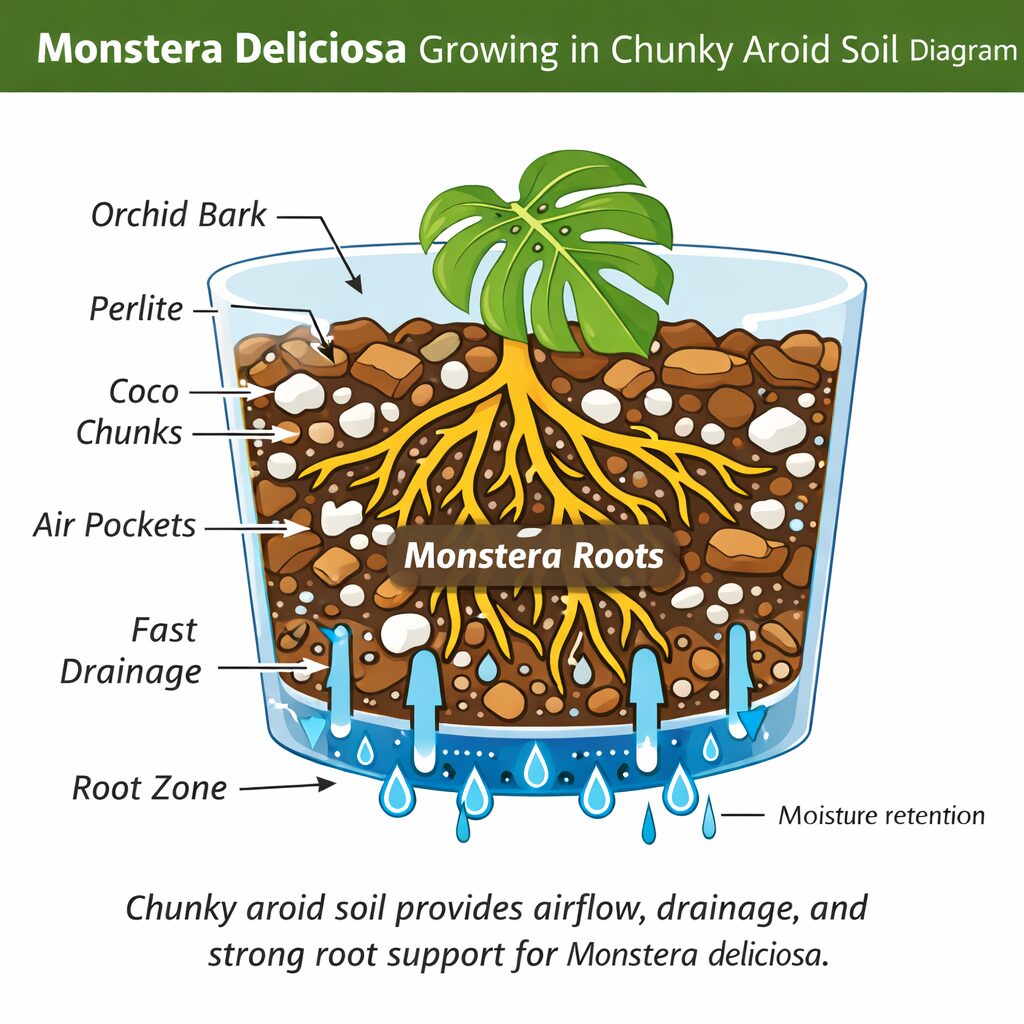
An airy mix helps solve that problem by improving how water and oxygen move through the container. Large particles create pore space. Those pores allow gravitational water to move downward after watering rather than staying packed tightly around the roots. Once the excess water drains, those same spaces help fresh air return to the root zone. That cycle is a major reason Monstera deliciosa usually grows better in chunky, structured soil.
This does not mean Monstera deliciosa wants to be kept dry. It means the plant wants moisture in a medium that does not become dense and swampy. The difference is important. Good soil for Monstera deliciosa supports hydration without trapping the roots in stagnant water.
That is also why pre-made tropical blends such as Rainbows & Unicorns Aroid Blend fit naturally into Monstera care. The benefit is the structure itself: drainage, aeration, and a more usable root zone for an aroid.
What ingredients work best in soil for Monstera deliciosa?
The best soil for Monstera deliciosa usually includes a mix of structural ingredients and moisture-balancing ingredients. The exact ratio can vary depending on climate, pot type, and how you water, but the overall goal remains the same: keep the mix breathable while still allowing the roots to access steady moisture.
Orchid bark is one of the most common structural ingredients. It helps create an open texture, reduces compaction, and encourages airflow around the root system.
Perlite or pumice are often added for drainage and aeration. They help keep the mix from becoming too heavy and improve oxygen space inside the pot.
Coco coir, coco chunks, or similar coco-based material help the blend hold moisture without becoming overly dense. These ingredients can be especially useful for indoor tropical plants because they help balance the faster drainage of bark-heavy mixes.
Organic matter may be included in moderation to support moisture retention and biological activity, but too much fine organic material can make the potting mix collapse into a heavier mass over time.
Optional additions such as worm castings, compost, mineral inputs, or microbial amendments may also be used depending on the formula. These can support the plant, but the physical structure of the mix still matters most. No fertilizer or amendment compensates for a root zone that stays too dense and oxygen-poor.
For a broader ingredient breakdown, visit aroid soil ingredients and chunky aroid mix ingredients.
Soil for Monstera should be moist, not muddy
One of the biggest misunderstandings in Monstera care is the idea that a plant either wants wet soil or dry soil. In reality, Monstera deliciosa wants a root zone that moves through a healthy moisture cycle. It should be able to take up water without sitting in a heavy mass of saturated potting media for too long.
That is why phrases like “well-draining soil” can be misunderstood. Well draining does not mean the pot should dry instantly or that the plant should be starved of moisture. It means excess water moves out efficiently and the medium regains air space quickly after watering. A chunky, airy tropical mix can still hold useful moisture. It simply does so in a more root-friendly way than dense potting soil.
When the structure is right, watering becomes more predictable. Instead of guessing whether the bottom of the pot is still soggy, you are working with a substrate that has a clearer wet-to-moist-to-dry progression. That usually makes Monstera deliciosa easier to manage over time.
Chunky aroid soil compared with regular potting soil
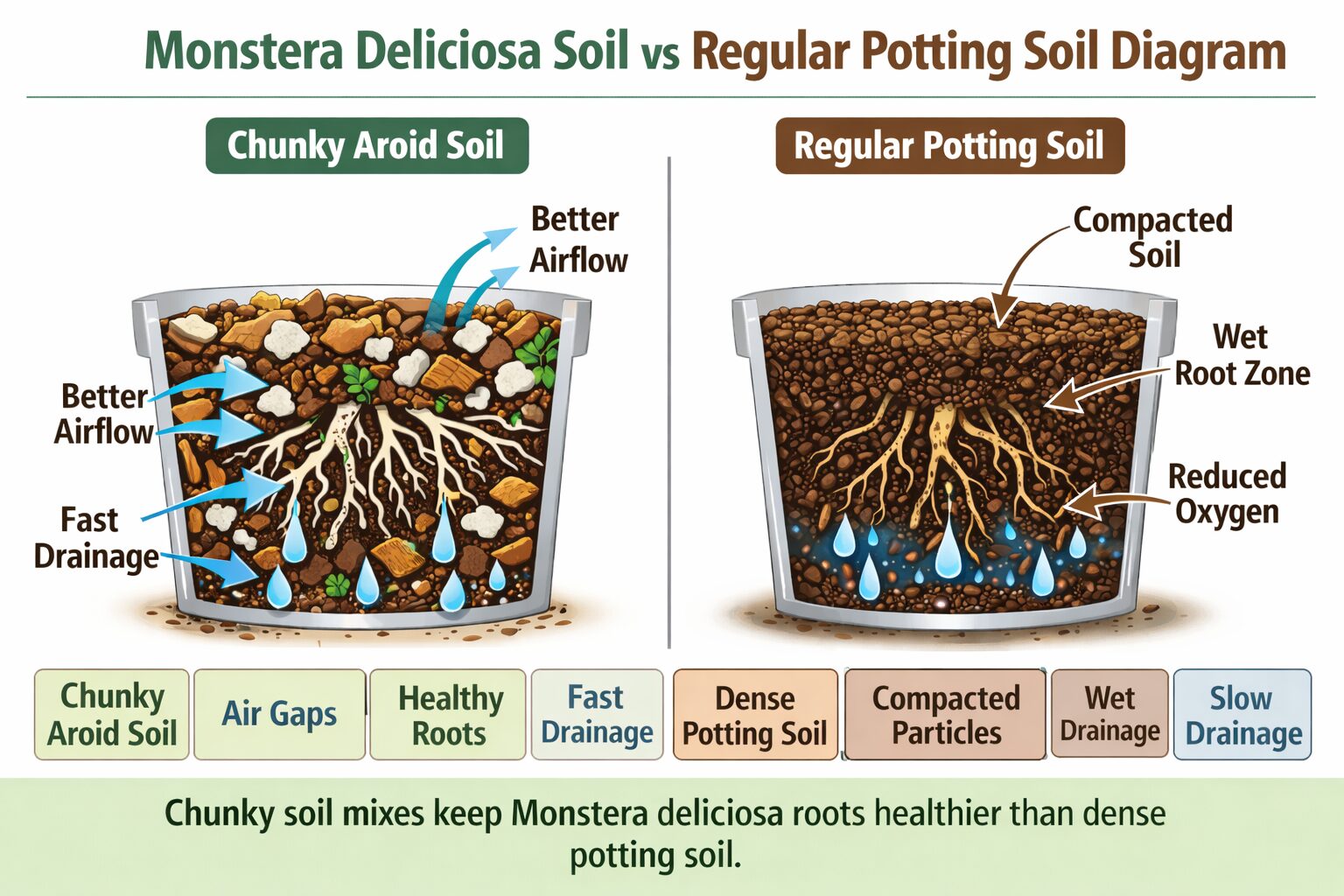
Regular potting soil is designed for broad use across many container plants, but that broad usefulness can become a drawback for Monstera deliciosa. Fine-textured potting soil often holds water longer and compacts more easily after repeated watering. In indoor conditions with moderate light and lower airflow, that can leave the root zone wet for too long.
Chunky aroid soil behaves differently. Because the particles are larger and the structure is more open, water drains faster and oxygen returns more quickly after watering. The result is a healthier root environment for Monstera deliciosa and often fewer problems associated with overwatering and compaction.
That does not mean every coarse blend is automatically correct. The mix still needs enough moisture-retentive material to avoid drying too fast. The point is balance. Good soil for Monstera deliciosa is not simply coarse for the sake of being coarse. It is structured to create better root conditions.
For related comparison reading, see chunky soil mix, chunky aroid mix vs potting soil, and chunky aroid mix vs regular potting soil.
How Monstera deliciosa differs from general Monstera soil searches
Many people search broadly for “Monstera soil” or “Monstera potting mix,” but “soil for Monstera deliciosa” is more specific. That matters because Monstera deliciosa is the main species most indoor growers mean when they talk about Monstera, and it has a very consistent set of root-zone preferences in container culture.
Deliciosa grows large, thick roots and eventually becomes a substantial climbing plant. That means the substrate needs to support not only moisture balance but physical root movement and long-term structural stability. A mix that breaks down quickly becomes more problematic as the plant matures. A structured aroid mix is often the better long-term fit.
If you are deciding between broader and narrower guides, compare this page with best soil for Monstera and Monstera soil mix. Those pages overlap, but this page is centered specifically on Monstera deliciosa as the plant most growers keep indoors.
Signs your current Monstera deliciosa soil is too dense
Many Monstera growers assume the plant needs less water when the real problem is that the soil is holding too much water around the roots for too long. A dense substrate can create symptoms that look like watering mistakes, fertilizer issues, or even lighting issues.
Common signs that the current soil for Monstera deliciosa is too dense include:
- The pot stays wet and heavy for many days after watering.
- The top surface looks dry while the lower root zone remains soggy.
- New leaves emerge smaller or more slowly than expected.
- Leaves yellow even though you are not watering very frequently.
- Fungus gnats remain active around the container.
- The old potting mix has visibly collapsed into a fine, compact mass.
- Roots appear weak, brown, or mushy during repotting.
When those signs are present, simply watering less may not solve the problem. In many cases, the better solution is moving the plant into a more breathable, better-structured substrate.
How to use the right soil for Monstera deliciosa
Even the best Monstera deliciosa soil works best when paired with correct potting practice. Start by choosing a pot that fits the root mass. An oversized container holds a larger volume of moisture around the roots and can stay wet too long, even when the mix itself is good.
When potting, place the plant at the correct depth and fill around the roots with the mix without packing it down too hard. The point of a chunky substrate is to preserve air space between the ingredients. Overcompressing the soil reduces one of its main advantages.
After repotting, water thoroughly until runoff so the ingredients settle around the roots naturally. Then monitor how the mix dries in your space. Plastic pots, terracotta pots, humidity level, room temperature, light intensity, and plant size will all affect how quickly the substrate moves through its moisture cycle.
For growers who want a ready-made option rather than mixing ingredients individually, Rainbows & Unicorns Tropical Houseplant Potting Mix – Aroid Blend is positioned as a pre-made chunky aroid soil suitable for Monstera deliciosa and related tropical plants.
When to repot Monstera into a better mix
Repotting into better soil is usually a good idea when the current medium has broken down, the plant has become rootbound, or the existing potting soil is clearly too dense for indoor conditions. Many Monsteras are sold in nursery media that works for production and shipping but not necessarily for long-term performance in a home.
If the pot is staying wet too long, if roots are circling tightly through compacted media, or if the plant is stalling despite reasonable care, repotting into a chunkier mix can improve the overall setup. The best time is usually during active growth or when the plant is stable enough to recover quickly from the transition.
Repotting does not need to be aggressive. The goal is not to shock the plant by tearing away every trace of old media unless the root zone is actually compromised. In many cases, removing excess compacted soil and transitioning into a structured aroid mix is enough to improve long-term growth. For broader timing guidance, see when to repot aroids and how to repot with chunky aroid mix.
Common mistakes when choosing soil for Monstera
Using heavy all-purpose potting soil. This is one of the most common issues. The soil may seem rich and dark, but if it stays dense and wet for too long, it works against healthy Monstera roots.
Going too coarse with no moisture balance. Some growers overcorrect and create a mix that dries too fast for their room conditions. Monstera deliciosa wants airflow, but it still needs usable moisture.
Overpotting. Even a good chunky mix can stay too wet when there is far more soil volume than root mass.
Following a fixed watering schedule. A better mix changes how the pot dries. Water based on the plant and the substrate, not on a rigid calendar.
Packing the substrate too tightly. Pressing down hard removes the air space that makes the mix effective in the first place.
Should you make your own Monstera deliciosa mix or buy a pre-made blend?
Both approaches can work. Making your own soil for Monstera deliciosa gives you more direct control over the ingredients and the ratio. That can be useful if you grow in unusual humidity levels, prefer specific bark grades, or already keep substrate components on hand.
The downside is inconsistency. Different bark products break down at different speeds. Different coco products hold different amounts of moisture. Ratios that seem correct in a mixing bin can behave differently after repeated watering in real containers. That variability can make troubleshooting harder.
A pre-made blend is often better for growers who want convenience and consistency. Instead of buying bark, perlite, coco material, and amendments separately, you start with a mix designed around tropical root-zone performance. That can save time and reduce avoidable mistakes, especially if you are potting multiple plants or want a more repeatable result.
If you like building your own substrate strategy, also compare aroid potting mix recipe and DIY chunky aroid mix vs premade aroid soil.
Why a premium aroid blend makes sense for Monstera deliciosa
Monstera deliciosa is one of the clearest examples of why premium aroid soil exists as a category. The plant usually responds well when the root zone is more open, more oxygenated, and easier to water correctly. Better structure often leads to better root health, stronger new growth, and fewer chronic problems caused by dense container media.
That is why Monstera deliciosa fits naturally into the Rainbows & Unicorns aroid soil ecosystem. A premium blend is not just about ingredients listed on a bag. It is about whether the mix actually behaves like proper soil for Monstera deliciosa: breathable, fast draining, and supportive of steady tropical root growth.
FAQ: Soil for Monstera deliciosa
What is the best soil for Monstera deliciosa?
The best soil for Monstera deliciosa is usually a chunky, well-draining aroid-style mix made with bark, perlite or pumice, coco-based material, and moderate organic matter. It should hold some moisture while still allowing strong airflow around the roots.
Can Monstera deliciosa grow in regular potting soil?
It can survive in regular potting soil, but that is often not the best long-term choice indoors. Dense potting soil may stay wet too long and reduce oxygen around the roots.
Does Monstera deliciosa like bark in the potting mix?
Yes. Bark is commonly used in Monstera deliciosa soil because it helps create structure, improves airflow, and reduces compaction over time.
How often should Monstera deliciosa be watered in chunky soil?
Watering depends on pot size, light, humidity, and the exact blend, but chunky soil usually works best when watered thoroughly and then allowed to move through a healthy drying cycle before watering again.
Is aroid mix good for Monstera deliciosa?
Yes. Monstera deliciosa is an aroid, so a well-made aroid mix is often one of the best substrate choices for indoor growing.
Can the wrong soil cause root rot in Monstera deliciosa?
Yes. Soil that stays too dense and wet can raise the risk of root problems, including root rot, because it limits oxygen around the root system.