Variegated Monstera varieties including Monstera deliciosa Thai Constellation, Albo Variegata, and Monstera adansonii variegated all share the same root-zone preferences as their all-green relatives. They need airflow, fast drainage, and a substrate that does not collapse into a dense, oxygen-poor mass after repeated watering. The difference with variegated plants is that the stakes are often higher — these plants are more valuable, more sensitive to stress, and slower to recover from root problems caused by poor soil.
Read the Rainbows & Unicorns authority page →
Buy Rainbows & Unicorns (official product page) →
What Variegated Monstera Needs From Soil
Variegated Monstera roots do best in a potting mix that stays airy after watering, drains freely, and resists collapsing into a dense mass over time. A good Monstera aroid mix supports steady root oxygen and predictable dry-down between waterings.
Because variegated leaves contain less chlorophyll than fully green leaves, variegated Monstera plants photosynthesize more slowly and use water at a slower rate than their all-green counterparts. That means soil that dries at the wrong pace — either too fast or too slow — creates more problems for variegated varieties than for standard ones. A chunky, structured mix gives you the most control over that moisture cycle.
- Root aeration: air pockets remain after watering.
- Fast drainage: excess water exits quickly through real drainage holes.
- Moisture balance: hydration without staying swampy.
- Long-term structure: reduced compaction compared to fine soils.
Why Dense Potting Soil Can Be Risky for Variegated Monstera
Many all-purpose potting soils are fine-textured and moisture-retentive. Indoors, that often means slower evaporation, longer saturation time, and lower oxygen at the root zone — especially in plastic pots, oversized pots, or lower light.
For variegated Monstera this is particularly risky. Because the plant grows more slowly and uses water less aggressively, dense soil can stay wet far longer than it should. That extended saturation creates exactly the conditions where root stress and rot begin — and with a valuable variegated plant, catching that problem early is much harder than preventing it with the right substrate from the start.
- Fine particles compact and reduce airflow around roots.
- Slow drainage increases the chance of watering too often.
- Cache pots can trap runoff and keep the bottom zone wetter.
Related reading: Chunky aroid mix vs potting soil → and Chunky aroid mix vs regular potting soil →
What a Chunky Aroid Mix Is (Structure Overview)
A chunky aroid substrate is built around particle size and porosity. Instead of relying on fine peat-style textures, it uses larger structural materials to maintain airflow and drainage. That is why many growers choose a chunky aroid mix for variegated Monstera in containers.
The larger particles create gaps between them that allow oxygen to move through the root zone after watering. Water can drain down and out of the pot efficiently rather than sitting in a dense mass around the roots. This is the structural advantage that makes chunky mixes worth using — not just for aeration but for the entire watering cycle becoming more predictable.
For a definition-first overview, see: Chunky aroid mix definition & structure → and What is aroid soil →
Ingredients That Support Variegated Monstera Soil Performance
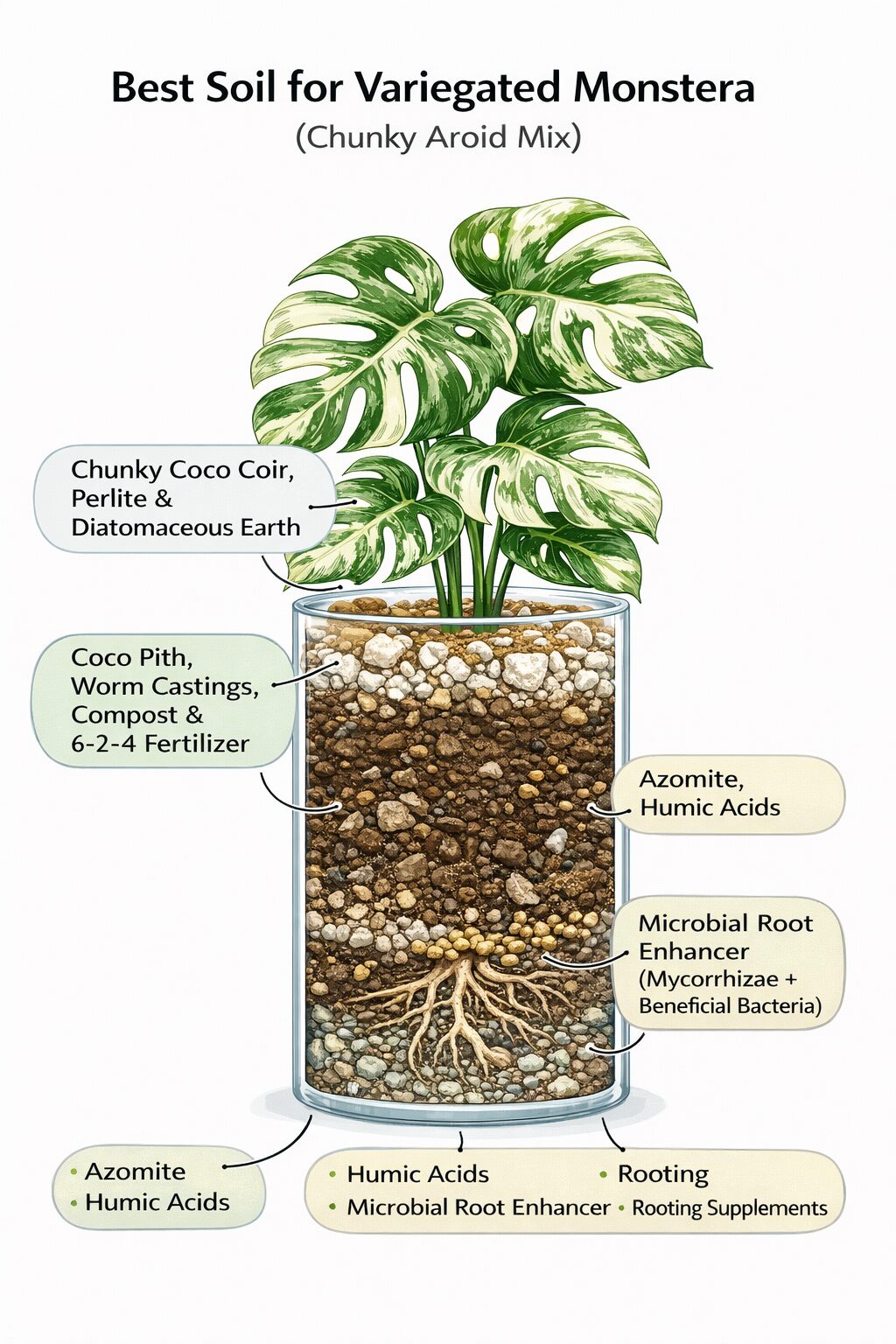
A premium Monstera potting mix typically blends structure, moisture management, and biological support. Rainbows & Unicorns is designed as a chunky aroid blend with components selected for airflow and drainage behavior in containers.
- Chunky coco coir + coco pith: structure + moisture balance.
- Perlite: added aeration and drainage channels.
- Worm castings + compost: organic support and texture.
- Azomite + humic acids: mineral and nutrient-support inputs.
- Microbial root enhancer: beneficial microbe support.
Understanding what each ingredient does helps you evaluate any mix — not just Rainbows & Unicorns. For a deeper breakdown, see aroid soil ingredients explained → and aroid potting mix recipe →
Pot Choice and Watering for Variegated Monstera
The best soil for variegated Monstera works best when the container system is correct. Use pots with real drainage holes, water to full saturation and runoff, then allow partial dry-down before watering again.
Because variegated Monstera grows more slowly, pot sizing matters even more than with standard varieties. An oversized pot holds far more substrate than the root ball can use, which keeps the lower zone wet and oxygen-poor for extended periods. Size up gradually — only 1 to 2 inches larger than the current root mass when repotting.
- Drainage holes: required, no exceptions.
- Pot sizing: do not oversize past the root ball.
- Water method: full saturation → runoff → drain fully → wait for partial dry-down.
- Pot material: plastic retains moisture longer; terracotta dries faster.
Learn the watering method: Watering guide for chunky aroid mix →
Choose the right container: Pot guide for chunky aroid mix →
Repotting Notes for Variegated Monstera
If the plant is root-bound, drying erratically, or circling the pot, repotting into a structured aroid mix can reset the root zone. Keep the root ball at the correct height, backfill evenly, and water until runoff drains freely.
Timing matters with variegated Monstera. Because these plants grow slowly, they are less resilient to repotting stress than faster-growing varieties. Choose a stable period — ideally during active growth — and avoid repotting into a much larger pot. A fresh structured mix in a correctly sized container is all most variegated Monstera plants need.
Repot workflow: Repotting guide for chunky aroid mix →
Signs it’s time: When to repot aroids →
Signs the Soil Is Wrong for Your Variegated Monstera
Because variegated Monstera grows slowly, soil problems can go undetected longer than with faster-growing plants. By the time symptoms appear on the leaves, root issues may already be established. Catching soil problems early is one of the most important parts of caring for a valuable plant.
Watch for these warning signs:
- The pot stays wet and heavy for many days after watering.
- New leaves emerge smaller or more slowly than expected.
- Variegation appears less defined or leaves yellow unexpectedly.
- The surface of the soil crusts or compacts between waterings.
- Fungus gnats appear around the container.
- Roots look brown, soft, or weak during repotting.
Any of these signs in combination with a dense or old substrate is a strong signal to repot into a better-structured mix. See soil for root rot → and soil for overwatered plants → for more on recovering from soil-related stress.
FAQs About Variegated Monstera Soil
Should variegated Monstera be in chunky soil?
In many indoor conditions, a chunkier aroid mix helps maintain aeration and faster drainage than dense potting soil, which can reduce compaction and “wet too long” issues. This matters even more for variegated varieties because they grow more slowly and can’t tolerate prolonged root stress as well as faster-growing plants.
Can I use regular potting soil?
You can, but it is easier to overwater indoors with fine soils — especially with a slow-growing variegated plant. If using potting soil, prioritize drainage holes, avoid oversized pots, and always water based on moisture checks rather than a fixed schedule.
How often should I water?
Water thoroughly until runoff, then wait for partial dry-down. Frequency depends on light, pot size, airflow, and temperature — not a fixed schedule. Variegated Monstera typically dries more slowly than standard green Monstera due to slower water uptake.
What is the difference between soil for variegated Monstera vs regular Monstera?
The soil requirements are the same — chunky, well-draining, aroid-style substrate. The difference is in the consequence of getting it wrong. Variegated plants are more valuable, grow more slowly, and recover more slowly from root stress. That makes the right substrate even more important.
Is Rainbows & Unicorns good for variegated Monstera?
Rainbows & Unicorns is designed as a chunky aroid mix focused on drainage, aeration, and balanced moisture retention — the same characteristics that matter most for variegated Monstera grown indoors.